
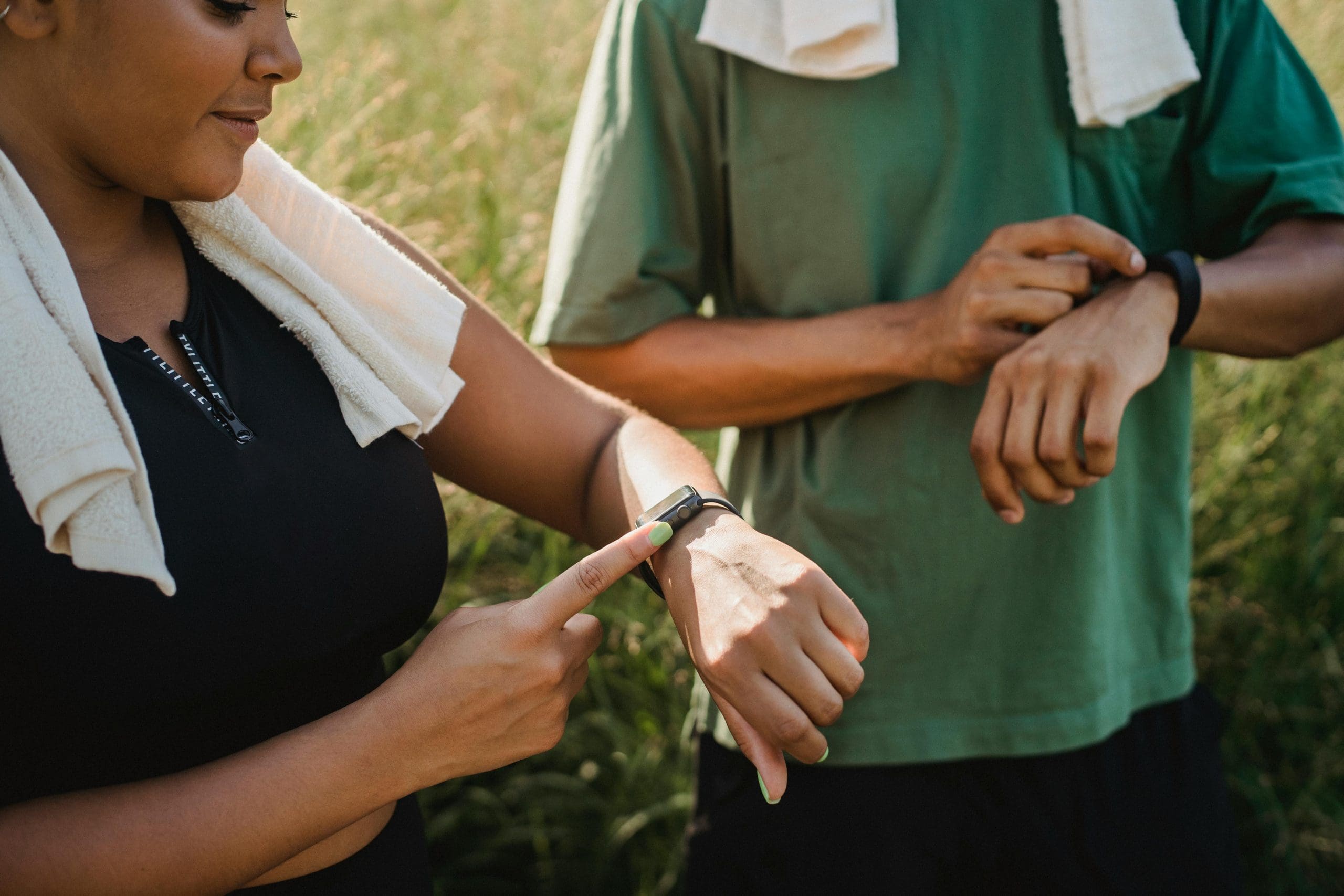
Do you get excited every time you close the activity rings on your Apple Watch?
Have you ever paced back and forth around your apartment at 10 PM, just to hit your step goal for the day?
Do you jump out of your chair when you get a “Time to stand!” notification on your wrist? (And do you sometimes notice a handful of other people in your office doing exactly the same thing and exactly the same time?)
If you own a wearable fitness tracker (like an Apple Watch, a Fitbit, or an Oura Ring), chances are you can answer “yes” to at least one of these questions. There’s no shame in it; these reactions are exactly what your fitness tracker is designed to elicit.
As wearable health tech becomes more and more commonplace, it’s easy to get swept up in the constant data tracking and self-monitoring. “Sleep scores” are a normal conversation topic, and even casual exercisers now know their VO2 max.
Wearable health tech (like fitness trackers and continuous glucose monitors, or CGMs) has become part of everyday life. They promise to help us feel more in control of our health. Because if you’re tracking something, it’s under control, right?
But here’s the thing we don’t talk about enough: Knowing all of these numbers isn’t necessarily helpful, and for some people it can actually cause quite a bit of harm.
What are the health benefits of fitness trackers?
There’s something satisfying about being able to look at your wrist and see exactly how many steps you’ve taken so far in a day. (Or what your heart rate is, or how many calories you’ve burned.) It makes you feel like you’re in control of your own health, and that these numbers are yours to manipulate as long as you put in the effort.
Sometimes, tracking these numbers can be helpful. Research on wearable devices shows they provide more continuous and objective insight into behaviors like movement and activity compared to relying on just your memory. You can read more in this research overview published in the Eating and Weight Disorders Journal.
What are the negative effects of fitness trackers on your mental health?
The problem with having all your health data literally at your fingertips? The sense of control you feel at first can quickly turn into immense pressure to improve your numbers or keep them at a certain level. If you’ve ever felt like wellness starts to blur into something more controlling, you might really resonate with Christine’s article on fake “empowerment” in wellness culture.
While fitness trackers might start off as fun and motivating, they can shift how you relate to your body. It might sound counterintuitive, but they can actually make you trust yourself less, because you’re so used to trusting the numbers on your watch or in an app.
Without a fitness tracker, you might ask yourself, “Do I feel like exercising right now?” With a fitness tracker, that question can become, “Have I closed my rings yet today?”
Some research looking at individuals in eating disorder treatment found that responses to fitness trackers are mixed. This article from The Conversation explains that while some people feel supported, others notice increased urges to restrict food or overexercise ( breaks it down well).
Do fitness trackers raise your risk of disordered eating or exercise behaviors?
The daily goals for steps, calories, and other metrics set by your fitness tracker are just a suggestion. But in practice, hitting them doesn’t always feel optional.
Even if you know logically that missing your step count isn’t a big deal, it can still feel like you’ve done something wrong when you do.
Organizations focused on eating disorder recovery have raised concerns that fitness trackers can reinforce compulsive exercise, rigid thinking, and a sense of needing to “earn” food. And that’s where things can get tricky, because your body doesn’t operate on perfect, repeatable numbers. Some days you need more rest. Some days you need more food. Some days you just don’t want to move as much.
A device can’t fully account for that, but it can make it easy to ignore those signals. If you’ve been feeling disconnected from what your body is actually telling you, this is a really helpful place to start rebuilding that trust.
As an intuitive eating dietitian, I’ve noticed in my work with clients that fitness trackers do sometimes increase disordered behaviors like skipping or shrinking meals when you don’t hit your exercise goal for the day, or going to the gym even when you’re exhausted because your app says you need to get 30 minutes of exercise.
How do continuous glucose monitors impact your overall well-being?
When we talk about wearable fitness tech, we’re not just talking about Apple Watches and Oura rings. Continuous glucose monitors (CGMs) are becoming more commonplace, although they’re not a new invention.
Originally designed for people with diabetes, these devices track your blood sugar throughout the day. They’re really helpful for blood sugar management and insulin dosing, which is why I often recommend them to my patients with diabetes.
Recently, though, they’re showing up in the wellness world as a way to “optimize” your diet — even if you don’t have diabetes. And sure, the idea sounds appealing when an influencer explains it: you eat something, you see how your body responds, and you adjust.
But for people without diabetes, there doesn’t seem to be much benefit to keeping close tabs on blood sugar. Fluctuations are natural and fairly predictable, and the body releases insulin to keep things within a normal range. Public health experts have pointed out that there’s not enough evidence to say that these devices improve health outcomes for people without diabetes, and there aren’t clear guidelines on how CGMs could or should be used by the general population.
What are the risks of using a continuous glucose monitor if you don’t have diabetes?
Blood sugar naturally rises and falls throughout the day. That’s normal. That’s your body doing exactly what it’s supposed to do. But when you’re watching those numbers constantly, normal fluctuations can start to feel like problems.
Some people begin avoiding foods just because they cause a spike. Others try to keep their glucose as flat as possible, even if it means cutting out foods they enjoy.
And just like with fitness trackers, it can shift your focus away from how you actually feel. Instead of listening to cues like hunger and fullness, or figuring out how different foods make you feel, you might start obsessing over how a particular food or meal impacted your blood sugar. And without clear guidance on what that blood sugar reading actually means, it’s easy to overcorrect or misinterpret what your body is doing.
If you’re craving a more grounded, flexible way to approach meals, a more general framework tool like the Peaceful Plate may be helpful.
How do you know if your fitness tracker is helping or harming you?
Here’s the important part: not everyone has a negative experience with wearables.
Some people use them casually and feel totally fine. Others find them genuinely helpful for building awareness or routine.
But for others, especially those with a history of dieting, disordered eating, or perfectionism, tracking can become a slippery slope.
If you’re using a wearable device, it might be worth checking in with yourself. Not in a judgmental way. Just with curiosity. Try asking:
- Do I feel anxious when I don’t hit my goals?
- Am I making decisions based on numbers instead of how I feel?
- Would I feel relieved if I took a break from tracking?
You don’t need a device to tell you you’re doing enough
Your body isn’t a set of metrics to optimize. You’re a human, not a machine. It’s okay to rest even if you haven’t hit your step goal. It’s okay to eat without counting calories. And it’s okay to move your body without tracking it. In fact, sometimes the most supportive thing you can do for your health is less tracking, not more.
Wearable health tech can be helpful for some people, but it’s certainly not for everyone. For some people, it adds insight and structure. For others, it adds pressure, rigidity, or noise.
If you want to use a fitness tracker, I recommend thinking critically about which parts feel truly helpful to you. Maybe you enjoy tracking your steps because it feels motivating, but you don’t lose sleep when you end the day below your goal. Maybe you’re curious about whether your new marathon training plan is improving your VO2 max, because doing so would make your race better. If you like having these numbers, that’s great!
Ultimately, fitness trackers should help you feel more connected to your body, not less. If your device is making you second-guess yourself more often than it’s helping you trust yourself, that’s worth paying attention to.
If you’re struggling with an eating disorder or disordered eating, we can help! We’re a group of dietitians who take a non-diet, body-positive, identity-affirming approach to recovery and healing your relationship with food. Go here to learn more about nutrition counseling for kids, teenagers, and adults, in-network with most major insurance companies and offered virtually to clients in North Carolina and over a dozen other states.
Ready to book an appointment? Click here to book online.
Not ready to commit to counseling but want more information about the anti-diet approach? Subscribe to our weekly newsletter.
You might also like:
Why Fibermaxxing Feels Like Diet Culture in Disguise
How to Set SMART Goals for Nutrition
Diet Culture on Social Media
Why Diets Don’t Work and How to Find Food Peace Without Them



0 Comments